
Tek Dive Articles · 16 January 2019
Look Before You Leap
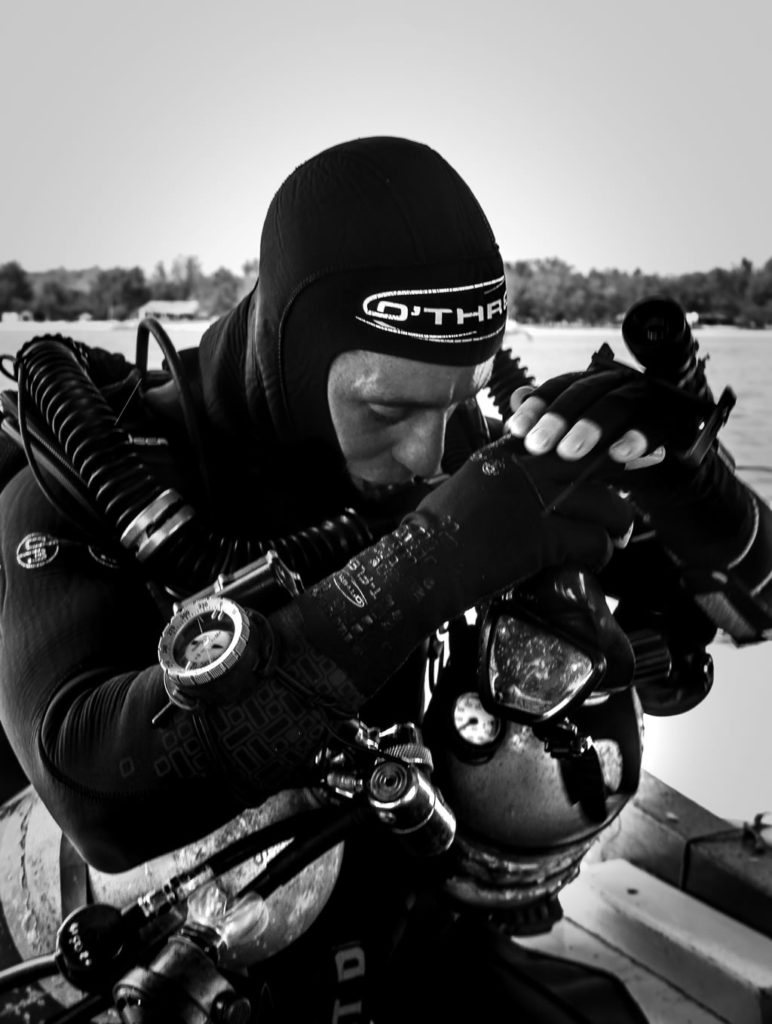
In the last issue of Asian Diver, we introduced the Blue Marlin Technical Dive Team. On the deep walls of Gili Trawangan, Indonesia, the team plans to set a new Closed Circuit Rebreather (CCR) depth record of 300 metres.
In order to plan the dive, our initial training focuses on understanding the inherent risks of deep CCR diving. The dive plan takes into account all the risks to the diver and puts together a procedure for a positive outcome for every eventuality. The first step, as with any dive plan, is to conduct a thorough risk assessment. Will Goodman and Simon Liddiard’s extensive experience in deep diving, along with current information readily available online, has helped to make Will’s dive possible. Online access to decades of research in decompression algorithms, scientific papers and physiological knowledge is invaluable alongside modern training principles, accident reports and technological advances in equipment.
Loss of vision
200 metres is the absolute limit for natural light to penetrate. We are spoilt by the warm, clear, nutrient-rich waters of Indonesia, which negate the use of a light even on a 150-metre deep trimix dive. We are sourcing compact torches with a suitable depth rating and the duration to last the deep portion of the dive. The effects of diving into the darkness may also have an adverse psychological effect. This will be managed by conducting progressive training dives so Will can adapt to the environment.
Computer failure
Most dive computers, timers and watches have a 200-metre depth rating. Time and decompression obligations are absolutely critical to diver safety. The JJ-CCR is controlled by a Shearwater handset, which has never been tested by a diver beyond 240 metres. The triple-redundancy design of the JJ-CCR allows oxygen injection to continue in the event of computer failure, the PO2 of the breathing mix can be monitored on the independently calibrated HUD, and if the solenoid fails the diver can manually inject oxygen to maintain optimum PO2. For decompression information we will use Liquivision X1 and XEO computers calibrated to 500m that can externally monitor the PO2 in the loop. The current 283-metre record was conducted using a Liquivision X1, the only one of seven computers tested that worked throughout the dive.
Hypothermia
Cold is a major factor in decompression sickness due to reduced blood flow. Excessive depths, thermoclines and high concentrations of helium add up to a lot of underwater time. Helium is essential to reduce PO2 and nitrogen narcosis, but it increases the decompression schedule and conducts heat away from the body very quickly. In 2010 O’Three sponsored Will’s longest open saltwater scuba dive by providing a semi-dry wetsuit that kept him warm for 48 hours; we have chosen this suit again. We decided not to use dry suits, as in our previous experience we were actually colder using them.
Decompression sickness
The bends is a risk with any dive. Cold, dehydration, rapid ascent and poor physiology are all contributing factors. Most technical divers prefer a CCR as the warm, moist gas reduces the risk of cold and dehydration. The constant PO2 setpoint means the diver is consistently delivered the optimum breathing mix regardless of depth, making a CCR more efficient at reducing decompression times while eliminating gas switches and task loading on ascent.
CNS and pulmonary oxygen toxicity
Central nervous system oxygen toxicity is the result of breathing a high PO2 for too long, and can end in a convulsion underwater. To minimise nitrogen loading and accelerate decompression, a CCR diver normally dives a setpoint of 1.2 or 1.3, but there is a risk of the PO2 spiking at depth. We plan to use a setpoint of 1.0 for the dive and take a five-minute air break every 20 minutes once we reach our CNS limits, switching to a lower PO2 during the decompression phase. Pulmonary oxygen toxicity, measured in OTUs, results from breathing a PO2 higher than 0.5 for extended periods; healthy lungs and a CCR with warm, moist gas will help as we may exceed the 850 OTU single-dive maximum.
HPNS
High-Pressure Nervous Syndrome affects the brain cortex, spinal cord and nervous system, causing dizziness, nausea, tremors and changes in brainwave activity. It is primarily caused by the compression rate of helium below 180 metres. We aim to reduce its effects by slowing down the descent and therefore the rate at which gas is absorbed. The training dives will incorporate a moderate trimix with a 30-metre END and one dive using heliox, testing both methods with our primary focus on work of breathing while managing HPNS.
CO2, the diver’s enemy
A rebreather relies on a chemical scrubber to remove the CO2 produced by the diver, normally lasting three to four hours. Should the absorbent fail, a CO2 hit will quickly follow, with symptoms including difficulty breathing, loss of motor skills, panic and eventually unconsciousness. Below 200 metres there is also the risk of respiratory failure due to increased gas density. We plan to reduce the risk by changing to a fresh CCR with unused absorbent during deco and by maintaining a calm, relaxed breathing pattern throughout the dive while minimising workload.
The training so far
The first few training dives started in a pool, trying out equipment configurations while fully kitted and handling multiple stage tanks. A series of 50 shallow dives to 40 metres ensured equipment familiarity, buoyancy and comfort. Will then progressed to intermediate Trimix dives to 60 metres, before three deep training dives to a maximum depth of 110 metres. During the deepest dive a full open-circuit bailout from depth was successfully completed without assistance, with Will carrying four 11-litre stages, two reels, two SMBs, three computers, cutting devices, slates and a spare mask.
← All articles