
Tek Dive Articles · 17 January 2019
Gearing Up For Teamwork
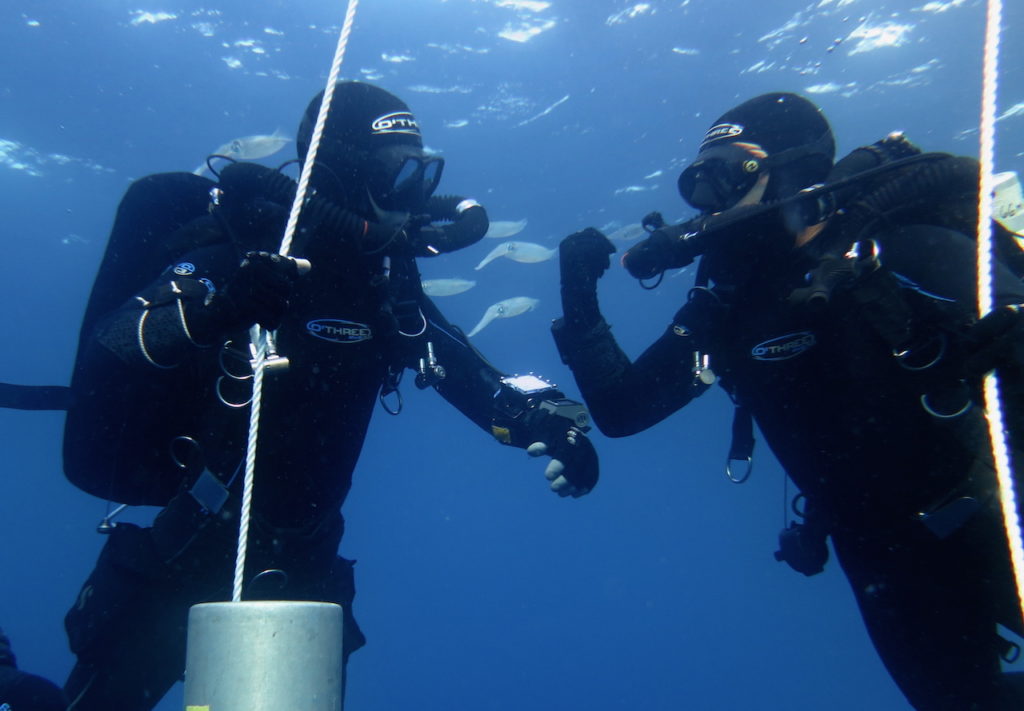
In this issue we outline Will’s next step and the teamwork needed for a dive to 220m supported by eight JJ-CCR divers. The team will descend down a sheer rock face following the descent line we successfully tied off to 180m last month. The support divers will stage the bailout gases for Will and various other team members along this line. We estimate the deepest support divers will wait at 180m, leaving Will to descend alone to 220m for this dive and 300m for the record dive.
Equipment adjustments
One adjustment, suggested by deep support diver Jeff Glenn, concerns the JJ diluent and oxygen pressure gauges, normally located to the rear of the diver by the hip. To read them you must pull them down and look down, which is tricky while carrying four S80 stages. They are now rerouted over the shoulder so they are constantly in view.
Simon dives with no gauges at all, a controversial configuration. His argument is that high-pressure hoses are a weak point on a CCR: if a hose blows you lose all your O2 or all your diluent. An experienced CCR diver doing dives to this depth will know when either supply is exhausted even without gauges, because the PO2 would drop below the setpoint on the handset or HUD, in which case the diver plugs in the backup O2 supply, or the wing would not inflate and the ADV would not inject, in which case the diver plugs in the off-board diluent. So the backup procedure is the same whether or not gauges are fitted.
This technique is not recommended for recreational CCR divers and is only considered due to the magnitude of sub-150-metre dives. Will understands Simon’s reasoning but still prefers to dive with gauges to collect gas-usage data and to spot a low-on-gas situation before it occurs. The important point in technical CCR diving is that the diver must carefully weigh the benefits and hazards of different configurations and make their own choice, with familiarity always a big deciding factor.
A dedicated wing inflation cylinder will be used, with extra LPI from the onboard diluent as backup. A manual diluent addition button allows any of Will’s deep bailout mixes to be plugged in should the onboard diluent fail, which also reduces the inhalation effort of pulling on the ADV at depth, already noticeable past 150m.
The dive plan
The dive parameters are a descent rate of 30m per minute, ascent from 220 to 140m at 12m per minute, and 140m to the surface at 9m per minute, with gradient factors of 30/85. Air breaks are taken on 50% nitrox as the CNS for the dive is 180%. Twin S80s with a full-face mask safeguard against oxygen toxicity convulsions during deco.
The bailout plan includes a 50% reserve, with support divers further backing up these gases on the line:
- 3,365 litres of Trimix 4/84, with an equivalent narcotic depth of 30m to buffer HPNS and matched to the diluent
- 2,333 litres of Trimix 10/60 from 145m
- 1,970 litres of Trimix 15/50 from 75m
- 1,975 litres of Triox 30/35 from 39m
- 576 litres of Nitrox 50 for air breaks
- 1,872 litres of Nitrox 50 for deco from 21m to 9m
- 2,800 litres of Nitrox 80, which has less CNS than 100% and reduces deco time when added at 9m
All gases step up in O2 content while gradually coming off the helium. Particular care has been taken not to increase nitrogen by too much at any point, to avoid isobaric counter-diffusion and the risk of a vestibular bend.
Over the next two months Will, Simon and the Blue Marlin Tech Team will conduct several more configuration and teamwork training dives to a maximum depth of 240m before the record attempt.
← All articles