
Tek Dive Articles · 17 January 2019
It's All In The Mind
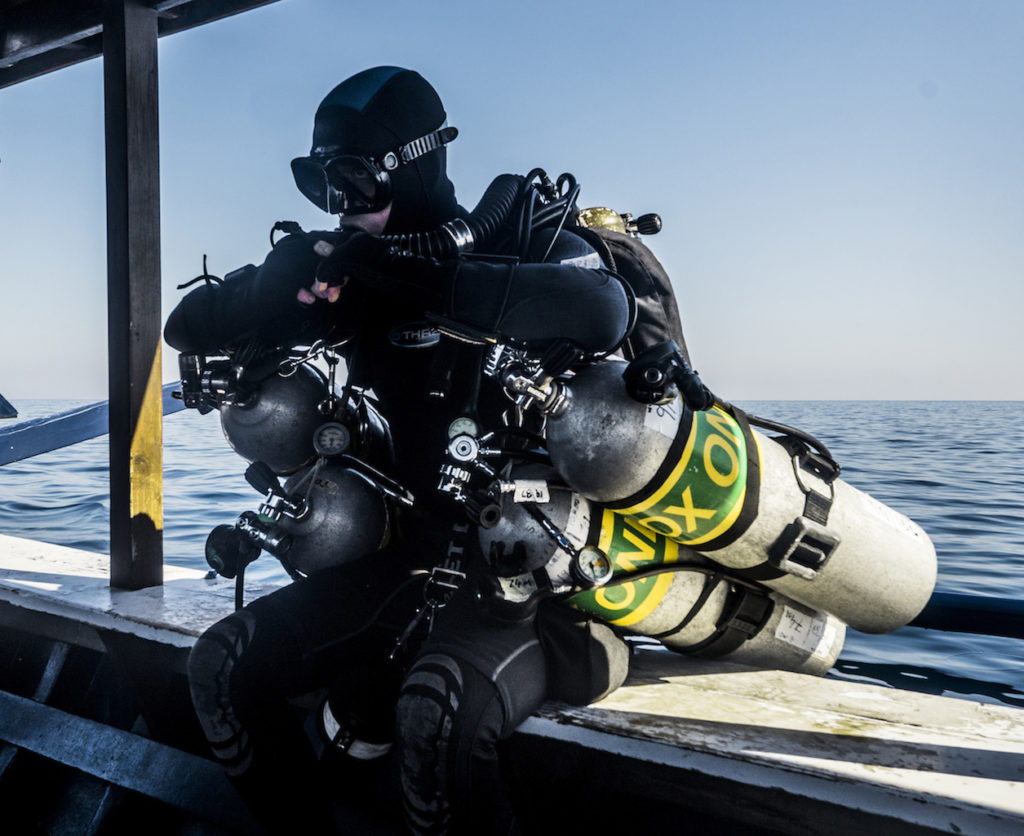
The technical diver’s mindset is a combination of attitude, discipline and mental preparation. In order to be mentally prepared for such deep dives a certain peace of mind is required. This Zen-like state is achieved through self-belief, the inevitable outcome after numerous successful training dives and being in peak physical condition.
“The last thing I want is self-doubt creeping in as I begin my descent, worrying if I have done enough. This could elevate my breathing rate, distract my focus and, as previously discussed, relaxation and focus while minimising work rate are critical if I am to safely ascend from 300 metres.”
Body and mind
Will’s weekly training schedule comprises two morning yoga sessions, three cardio workouts and three strength-training sessions. This, alongside a healthy diet and total abstinence from alcohol, ensures the best physical condition possible.
Will and Simon train and work together. This relationship builds admiration and trust, a critical trait your dive buddy must possess. Will first arrived on Gili Trawangan and met Simon Liddiard, owner of Blue Marlin Dive and a technical diving guru. Simon taught Will’s open-circuit TDI Advanced Trimix course and soon convinced Will he needed to learn CCR if he wanted to venture deeper.
Will completed his CCR and technical diver instructor ratings with Simon, and the pair became friends. They have been working together for almost nine years and know each other very well. They don’t only use their gym time for physical fitness; it’s a great way to clear the mind of negative thoughts and develop a positive mental attitude. As Simon always tells Will, “It’s all in the mind.”
Yoga is helping Will to control his breathing regardless of task, slowly finding a naturally efficient way to focus and breathe from his diaphragm. Seventy percent of gas exchange takes place in the lower part of the lungs, and diffusion of gas through the alveoli needs to occur perfectly for the necessary on- and off-gassing. His training sessions are designed to increase fitness, stamina and lung capacity while reducing body fat, including timed 5-kilometre runs, hill training and sprints, and a long, gentle recovery run around Gili Trawangan.
Setting up the line
We planned three dives to set up a descent/ascent line we could use for future training dives. The line allows us to stage bailout cylinders down to 150 metres, reducing the number of divers needed in the water and ensuring familiarity by conducting dives in precisely the same location.
The dive plans were made using MultiDeco software from V-Planner, incorporating Bühlmann theory with gradient factors of 15/85, matched to our Liquivision Xeos and Shearwater Predator controllers. We changed the minimum stop times to 30 seconds at depth, reducing deco by two hours in the shallows, set variable ascent rates, and a PO2 of 1.2 on the bottom and 1.3 for deco, with the last stop at four metres. Will used onboard S40 aluminium tanks for a large capacity of onboard diluent and O2, with an additional 3-litre air tank for wing inflation and a 2-litre O2 supply in case the primaries were lost.
Lay line to 100 metres
The 100-metre dive was probably the most complicated. We had to locate the top of Tunang Wall in a current using GPS. Once Simon had tied off to a rock, Will took the loose end over the wall and disappeared out of sight, allowing a five-minute descent from 41 to 100 metres. At 93 metres, Will found a solid rock protrusion on the edge of the wall and began tying off. They then ascended back to the top of the wall, adding additional tie-offs, and completed decompression without incident.
Lay line to 150 metres
At 120 metres, the wall became a slope covered in fine silt. Will, carrying four S80 bailout tanks and a JJ-CCR with three steel tanks, had to swim down the slope in search of depth, a dangerous task at which breathing can easily elevate and CO2 build up becomes a major concern. When he saw a huge rock outcrop at 140 metres on the edge of a sheer drop-off, he decided to tie off rather than chase 150 metres. The rope dragged behind had disturbed the silt and created near-zero visibility.
Will signalled he was over-exerted and at the end of his planned time. He started moving back up the slope, breathing faster than he would have liked, the current picking up and visibility at zero. He had to use all his training and mental willpower to remain calm and focused, and by 95 metres visibility and breathing were back on track.
On reaching 36 metres, a critical off-gassing depth, the buoy line was being pulled under by the current. Struggling to hold on, the team deployed SMBs and commenced a drift-decompression plan with surface boat cover. With nine minutes of decompression remaining at nine metres, the shallow reef they had worried about appeared directly in front of them; they dumped all air and found an indentation to hide in until their computers cleared the stop. Will surfaced with a slight pain in his elbow and, with symptoms persisting on land, the decision was made to run US Navy in-water recompression therapy using a full-face mask and safety diver. Two hours later Will surfaced symptom-free, with nothing more than a bruised ego.
Lay line to 150 metres and a dive to 180 metres
Simon and Will rethought their strategy. Simon would do the remaining line work, leaving Will free to relax and descend to 180 metres. The one-minute stops were reduced to 30 seconds at depth, reducing shallow deco by two hours, and five-minute air breaks were taken every 25 minutes during the last hour of decompression.
Will arrived feeling on top of his game, focused and relaxed. The dive began well and he was ahead of schedule throughout, able to see without a torch all the way down to 180 metres. At 160 metres he started adding gas to slow the free fall, levelling off at 176 metres a minute ahead of schedule. He took a moment to enjoy the surroundings, then turned to start the long journey back.
The ascent rate was 12 metres a minute to 140 metres, performed precisely. Reuniting with Simon, they began a nine-metre-per-minute ascent together. All was well until 39 metres, when Simon felt pain in his shoulder; he used a technique that had succeeded many times, descending until the pain subsided.
These working dives highlighted a critical factor: deep CCR divers should be aware of the danger zone on ascent. After hundreds of sub-120-metre dives, we have identified the 39-to-25-metre range as critical. An aware diver can treat a minor bend in the water and ascend asymptomatic. We are already planning the next instalment: the need for torches and an on-site recompression chamber for sub-200-metre dives.
← All articles